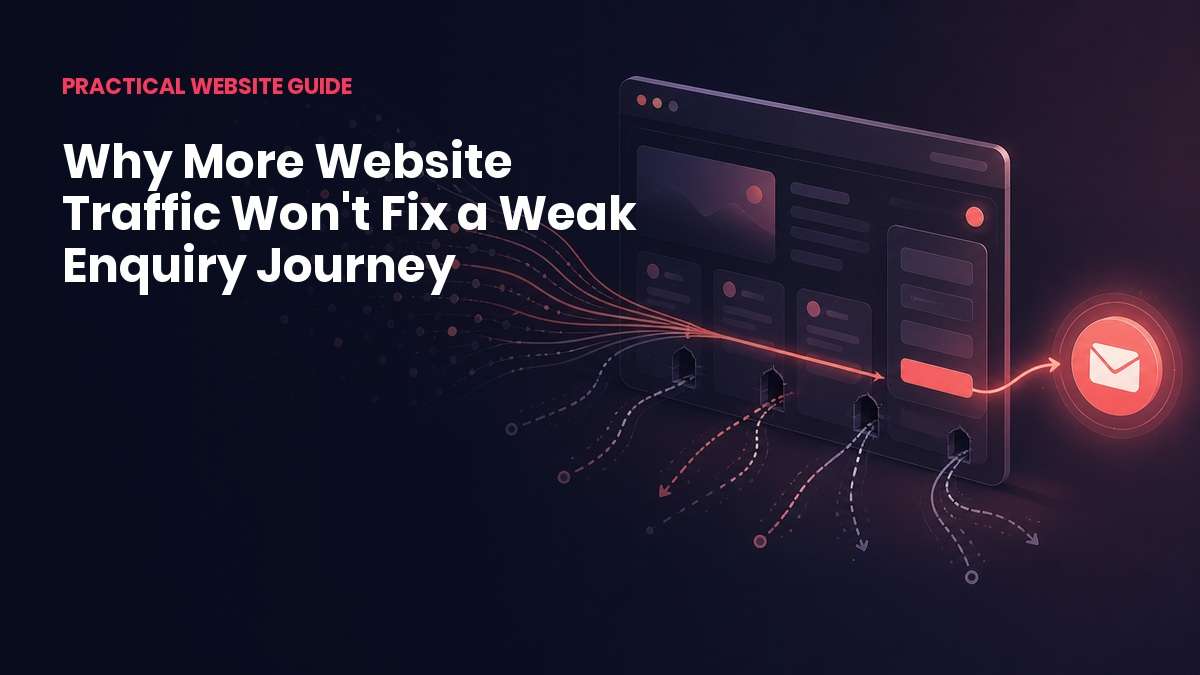
When a website is not producing enough enquiries, the obvious reaction is often to chase more visitors.
More SEO. More social posts. More advertising. More money pushed towards the top of the funnel.
Sometimes that is exactly what is needed. But if people are already reaching the website and not taking the next step, increasing traffic can be an expensive way to avoid the real problem.
Before trying to attract more people, it is worth checking what happens to the people who already arrive.
Traffic is only the beginning
A website visit is not the same as genuine interest, and genuine interest is not the same as an enquiry.
Between those points, a potential customer is quietly asking questions:
- Am I in the right place?
- Does this business understand what I need?
- Can I trust them?
- Is the service suitable for somebody like me?
- What should I do next?
They may never phrase those questions consciously, but the website still has to answer them. If it does not, many visitors will leave without explaining why.
Analytics may record a bounce or a short visit. The business simply sees silence.
Five common places where enquiries disappear
1. The opening message is too vague
Phrases such as “helping businesses succeed” sound positive, but they do not tell a visitor enough. A strong opening should quickly explain what you do, who it is for and why it matters.
The aim is not to squeeze the whole business into one sentence. It is to give the right person enough confidence to continue.
2. There is no obvious next step
A visitor should not have to hunt for a contact page or decide between six competing buttons.
The most useful next action might be to request a callback, book a conversation, ask for a quote or complete a short assessment. Whatever it is, it should be easy to find and feel appropriate to the stage the visitor has reached.
“Contact us” is functional. “Talk through your website with Paul” is clearer and more human.
3. The website makes claims without enough proof
Most businesses say they offer excellent service. Potential customers look for evidence.
Testimonials, relevant examples, named projects, before-and-after detail, clear processes and honest explanations all reduce uncertainty. A few specific pieces of proof usually do more work than a page full of broad claims.
4. The mobile experience creates friction
A site can look excellent on a large desktop screen and become awkward on a phone. Oversized headings, cramped buttons, slow images and long forms all make it easier to leave than enquire.
Testing the important pages on a real phone is one of the simplest and most valuable website checks a business owner can do.
5. The journey stops after the form
The enquiry process does not finish when somebody presses submit.
They should know their message has arrived, what will happen next and roughly when they can expect a reply. Where appropriate, a useful confirmation email can answer a common question or point them towards a relevant example while they wait.
That follow-up should feel helpful—not like they have accidentally joined an aggressive sales sequence.
A practical ten-minute review
You do not need specialist software to spot many of these gaps. Start with the pages a potential customer is most likely to see: the homepage, main service page and contact page.
Check each page for the following:
- Can a new visitor understand the offer within five seconds?
- Is there one clear next step?
- Is there visible proof close to the point where a decision is made?
- Does the page work comfortably on a phone?
- Does the enquiry process explain what happens next?
Ask somebody who does not work in the business to try it too. Familiarity makes it surprisingly difficult to notice what is missing.
Fix the closest obstacle first
Marketing becomes wasteful when every problem is treated as a traffic problem.
If the message is unclear, improve the message. If people do not trust the claims, strengthen the proof. If the next action is difficult, simplify it. If the website is doing its job but too few suitable people see it, then increasing reach becomes the sensible next move.
This order matters because it protects the budget. It also gives future SEO, content and advertising a much better chance of producing a return.
Not sure where your website is losing people?
The free Ascend Website Enquiry Scorecard takes around seven minutes and looks at the areas that influence whether a visitor becomes an enquiry. You will receive a practical result based on your answers and a sensible recommendation on what to address first.
Take the free Website Enquiry Scorecard: https://www.ascendmarketingltd.com/website-enquiry-scorecard/
There is no obligation and no inflated promise—just a clearer view of what may be helping, what may be getting in the way and what to do next.
Find the sensible starting point
Take the free 7-minute Website Enquiry Scorecard and receive a practical result based on your answers.