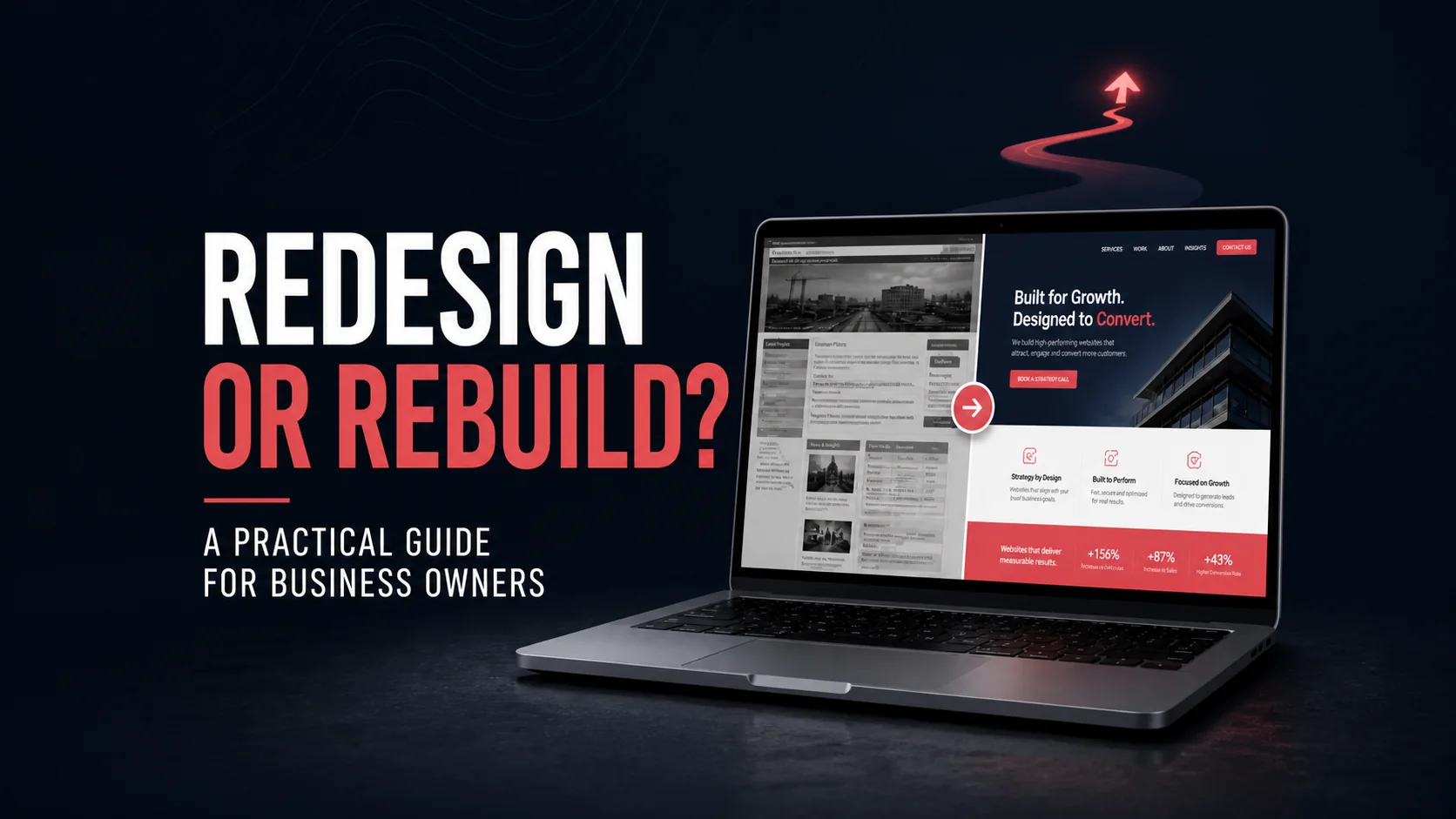
Website redesign or rebuild? It is a question many business owners face when their current site stops producing results.
Sometimes that is true. But sometimes the underlying website is perfectly workable and simply needs a clearer message, better structure and a more confident design.
The difficult part is knowing whether you need a thoughtful redesign or a complete rebuild. Choose the wrong option and you can either spend more than necessary or keep investing in a website that has already reached its limit.
Here is how I normally approach the decision with small business owners.
What is the difference between a redesign and a rebuild?
A website redesign improves the way an existing website looks, communicates and guides visitors. The underlying system may stay largely the same, while the layout, copy, imagery and customer journey are substantially improved.
A rebuild goes deeper. It replaces some or all of the technical foundations and gives us the opportunity to reconsider the site structure, templates, functionality and editing experience.
The finished websites can look equally different from what came before. The distinction is mainly about how much of the existing foundation is worth keeping.
When a website redesign may be enough
1. The business has changed but the website has not
Businesses naturally evolve. Services become more specialised, the ideal customer changes and the way you describe your value becomes clearer.
If the website still talks about everything you offered five years ago, visitors may receive the wrong impression even if the design is technically sound. Rewriting the key pages and reorganising the navigation can sometimes solve this without replacing the entire site.
2. The design looks tired but the website works reliably
A dated visual style can affect trust, particularly when competitors present themselves more confidently. That does not necessarily mean the technology underneath is unsuitable.
New typography, stronger spacing, more purposeful imagery and a consistent set of page components can transform a reliable WordPress website. The important thing is to improve the whole visual system rather than applying a few cosmetic changes to the homepage.
3. Visitors are not being guided towards an enquiry
Many websites contain all the right information but present it in the wrong order. Calls to action are inconsistent, important proof appears too late and service pages do not answer the questions customers actually have.
This is usually a structure and content problem. A focused redesign can create clearer routes from the first visit to the contact page, quotation form or relevant project.
Paul’s practical take: if the website works well behind the scenes but feels unclear to customers, begin by improving the message and journey before assuming the platform needs replacing.
4. The website is responsive but awkward on mobile
There is a difference between a site fitting on a phone and being pleasant to use on one.
Oversized headings, cramped buttons, long paragraphs and complicated forms can make an otherwise functional website frustrating. In many cases these issues can be addressed by rebuilding the page layouts and mobile styles while retaining the existing content management system.
When a complete rebuild is the sensible option
1. Making ordinary changes has become difficult
You should not need a developer every time you want to update a service, replace an image or add a useful page.
If the editing experience is confusing, fragile or dependent on outdated custom code, another visual refresh may only disguise the real problem. A rebuild can create a cleaner collection of reusable page sections that your business can maintain confidently.
2. The technology is limiting performance or reliability
Slow loading, repeated errors, plugin conflicts and security concerns are signs that the technical foundation deserves proper attention.
Individual fixes may provide temporary relief, but there comes a point when continuing to patch the website costs more time and creates more risk than rebuilding it properly.
3. The website needs functionality it was never designed for
A brochure website may later need online payments, bookings, gated resources, multilingual content or integration with a customer-management system.
Some features can be added cleanly. Others fundamentally change how the site should be organised. If a new requirement touches many pages and processes, rebuilding around that requirement is usually more dependable than forcing it into the existing structure.
4. The page structure is working against your SEO
Search visibility is not only about adding keywords to existing pages. The site needs a logical hierarchy, genuinely useful service content, sensible internal links and pages that load properly across devices.
If several services have been squeezed onto one page, URLs have changed repeatedly or important content is buried within a confusing navigation, a rebuild gives us the opportunity to create a cleaner SEO foundation.
That work needs to be handled carefully. Existing rankings, useful URLs and inbound links should be reviewed before anything is replaced.
5. Repeated improvements still have not solved the problem
Small adjustments are sensible when they are moving the website forward. They become wasteful when every change reveals another limitation.
If you have already paid for several rounds of fixes but the website remains slow, difficult to edit or poor at generating enquiries, the accumulated evidence may be telling you that the foundation has reached the end of its useful life.
Five questions to help you decide
Before commissioning either option, ask:
- Can the current website support the services and functionality we will need over the next few years?
- Can somebody in the business update it without worrying about breaking the layout?
- Does it perform reliably on ordinary mobile connections?
- Can we improve the customer journey without fighting the existing structure?
- Would keeping the current foundation genuinely save money, or merely postpone a rebuild?
The answers usually make the right level of work much clearer.
Do not judge the decision on initial cost alone
A redesign will normally involve less technical work than a rebuild, but the cheapest initial option is not always the best value.
If a modest redesign gives you another three productive years from a sound website, that can be an excellent investment. If it leaves you paying for fixes and workarounds every few months, the saving quickly disappears.
The useful question is not simply, “Which option costs less today?” It is, “Which option gives the business the clearest and most dependable route forward?”
Protect what is already working
A new website should not mean carelessly throwing away useful content, established search visibility or familiar customer journeys.
Before making major changes, identify:
- The pages currently attracting relevant search traffic
- The URLs receiving links or enquiries
- The content customers regularly mention
- The forms, tracking and integrations the business depends upon
- The elements of the current brand that customers already recognise
A responsible website design and rebuild protects these assets while improving the areas that are holding the business back.
What I recommend for most small businesses
Start with an honest assessment rather than choosing the solution in advance.
Look at the website as a customer, review how it performs technically and decide what the business will need from it over the next few years. That may reveal a relatively focused list of improvements. It may also confirm that continued patching would be false economy.
Either answer is useful. The objective is not to build the biggest possible project. It is to create a website that communicates clearly, is easy to manage and gives potential customers a straightforward reason to get in touch.
Not sure which route your website needs?
If your website feels dated or is no longer generating enough enquiries, I can help you separate the problems that can be improved from the ones that require a fresh foundation.
There is no need to decide between a redesign and rebuild before we speak. Request a straightforward website review from Ascend Marketing and I will give you an honest view of what is worth keeping, what needs changing and where your budget is likely to have the greatest impact.